Project: Rosemont College Increases Fund Donations
Vertical Market: Education
Business Application: Direct Marketing/Direct Order - Fundraising
Business Objectives
Rosemont College is a private liberal arts college located in Philadelphia, PA with an enrollment of approximately 900 students. Rosemont College wanted to launch their new Rosemont Experience Fund, which is part of a five year comprehensive fundraising campaign. Goals for the initial campaign launch were:
- Introduce the Rosemont Experience Fund
- Build momentum for the comprehensive campaign
- Increase alumni participation
- Increase dollars raised
Campaign Architecture
Rosemont College utilized multiple points of contact (direct mail, email, web, and social media) to connect with and draw donations from alumni, parents, and friends of the College. The program included four phases that lasted from October - June and worked in conjunction with the comprehensive campaign launched several months prior.
Phase One
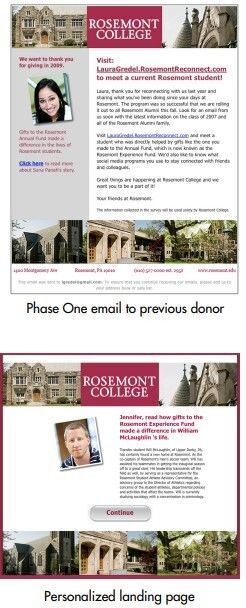
In October, Rosemont launched a “reconnect phase” that was aimed at engaging alumni who had previously not connected with the institution. This phase highlighted current students who were benefiting from the Rosemont Experience Fund. The featured students varied based upon the data available on the recipients (major, extra curricular, etc). The goal was to make an emotional connection between giving, and the benefits provided to students who held similar interests as the prospective donor. Direct mail and email were used to draw recipients to a Personalized URL where they could read about current students, complete an online survey about what they had been doing since graduation, connect with Rosemont's Facebook page, and ultimately make a gift to the Rosemont Experience Fund.
Alumni who had already connected with Rosemont College during the previous year's campaign received a thank-you email. They were encouraged to visit their Personalized URL for more information on the Rosemont Experience Fund.
Phase Two
In December, a second round of communications was sent to all alumni and parents, except for those who had donated in Phase One. The purpose of this phase was to introduce the comprehensive campaign as well as draw support for the Rosemont Experience Fund.
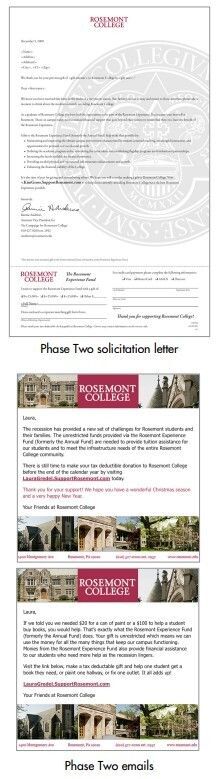
The first step was an email explaining the Fund and encouraging recipients to visit their Personalized URL to make a donation. A solicitation letter with a remittance envelope was sent next. The text of the letter varied based upon donor history. Recipients were encouraged to either visit their Personalized URL or use the enclosed envelope to make a donation.
A series of emails were also sent which highlighted the benefit of making a tax deductible donation before the end of the year. Three versions of this email with different subject lines and copy points were sent at random to the prospects. The response rates were tracking to determine which segments responded to which copy points, and this information was used throughout the remainder of the campaign to drive participation rates. The message themes and responses to the three versions were as follows:
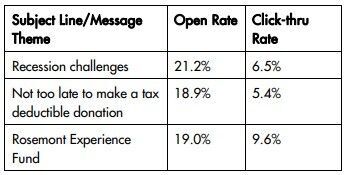
After running this test, the recession-themed message was used for all follow up emails to non-responders.
Finally, as a goodwill gesture to all prospects, an interactive holiday e-card was sent from the President of Rosemont College.
Phases Three and Four
Phases three and four communications highlighted specific examples of how a donation to the Rosemont Experience Fund could benefit students. Phase three was launched in March, and Phase four began in late May and wrapped up in early June.
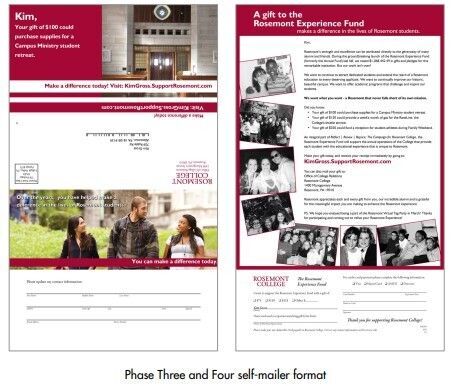
Similar to the previous phases, a combination of email and direct mail were used to reach prospects. Segments were created based upon the recipient’s involvement at the college and donor history. Highlighted donation examples varied based on this information.
Two versions of the direct mail were used in these phases – a solicitation letter delivered in an envelope and a self-mailer. The self-mailer was sent to donors from the previous year and to young alumni. The letter was sent to older alumni based upon feedback from this audience that they preferred this format. Both versions gave instructions to visit a Personalized URL to make an online donation or to use the enclosed reply form to mail in a donation. The reply form was variable based upon past gift amounts and current contact information.
List
The list for this campaign consisted of alumni, parents, and friends of the College from Rosemont’s database. The list did not include major donors as these individuals were approached separately.
Creative and Outbound Pieces
The creative for the emails, direct mail, and landing pages focused on images of Rosemont College and its students. All the pieces also used the College’s school colors of burgundy, white, gray, and taupe. This cohesive look was developed to elicit an emotional response from the target audience.
Reasons for Success
Rosemont College had previously used a multi-channel cross-media campaign to drive great results. With the help of our associated company, they repeated this winning formula.
Best Practices Learned
- Build a relationship before asking for money. The first phase of this campaign was focused on connecting with alumni and showing them how students with interests similar to their own benefitted from the Rosemont Experience Fund. Only after establishing this connection did the College ask for donations.
- Make it relevant. Throughout the campaign Rosemont strove to make communications meaningful for recipients. Profiled students had interests similar to those recipients had when they were on campus. Illustrations of what could be accomplished with donations to the Fund reflected the recipient’s giving level. All of these intentional connections helped to drive response and raise funds for Rosemont.
- Enable responses in multiple formats. Rosemont, which had not pushed online donations before, saw an increase in online giving through the use of Personalized URLs. However, they did not promote online giving to the exclusion of traditional response formats. With each mailing they included a remittance envelope, and this turned out to be the preferred donation format for Rosemont’s audience.
Results
Rosemont College successfully connected with alumni and parents to grow the Rosemont Experience Fund.
- 29% of recipients (2,361 individuals) visited their Personalized URL in response to either email or direct maiL
- Over $1,700,000 was raised in donations from 1,123 alumni and parents
24.4% of gifts were received via online donations
56.7% of gifts were received via a business reply envelope
Remaining gifts were received at events
- Average gift amount was $1,184.55
- Majority of donors either increased the amount of their donation or kept it consistent with the previous year’s giving level
29% of donors increased their gift size
36% of donors gave at the same level
7% of donors were first time givers